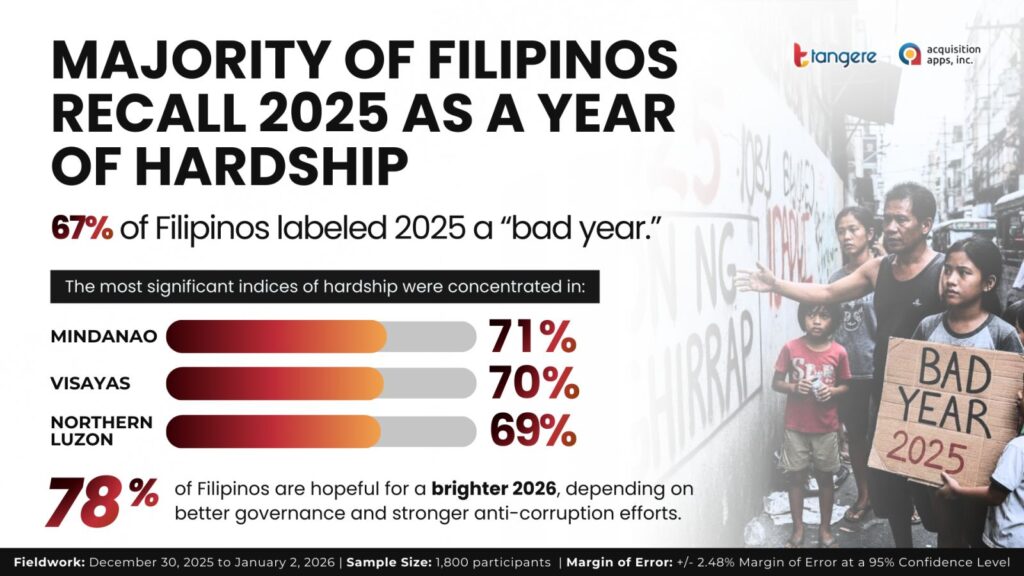
As the calendar turns, the Filipino sentiment reflects a nation grappling with a difficult past but looking toward a reformed future. According to the latest Tangere non-commissioned survey, a significant 67% of Filipinos categorized 2025 as a “bad year” for both their families and the nation.
The findings, gathered between December 30, 2025, and January 2, 2026, pinpoint government corruption and the devastating toll of natural calamities as the primary drivers of this national decline.
A Nation Under Pressure: The 2025 Hardship Map
The survey reveals that the burden of 2025 was felt most acutely in regions frequently hit by disasters and economic hurdles. The indices of hardship were highest in:
- Mindanao: 71% reported a year of adversity.
- Visayas: 70% reported a year of adversity.
- Northern Luzon: 69% reported a year of adversity.
The Accountability Gap: Beyond the DPWH
While the recent arrests of DPWH officials and contractors were noted by the public, they were seen as only the first step.
- 75% Demand Higher Accountability: Three out of four Filipinos believe true justice requires the prosecution of top-tier officials, including senators and congressmen linked to flood control anomalies.
- 20% Satisfaction: Only a small minority feel satisfied with the current level of arrests.
Looking Forward: The 2026 Optimism Pivot
Despite the challenges of the previous year, the Filipino spirit of “Pag-asa” remains robust. An overwhelming 78% of Filipinos are betting on a brighter 2026.
However, this optimism is conditional. The prevailing positive outlook is strictly contingent upon:
- Tangible improvements in Philippine governance.
- A more robust stance against institutional corruption.
Survey Methodology
This study was administered via the Tangere mobile-based respondent application with a sample size of 1,800 participants (Margin of Error: +/- 2.48% at a 95% Confidence Level). Using Stratified Random Sampling (Quota Based), the proportion was spread across the Philippines:
- 12% NCR
- 23% Northern Luzon
- 22% Southern Luzon
- 20% Visayas
- 23% Mindanao